NoOnes Funds Rejected? What to Do If Your Crypto Deposit Is Returned
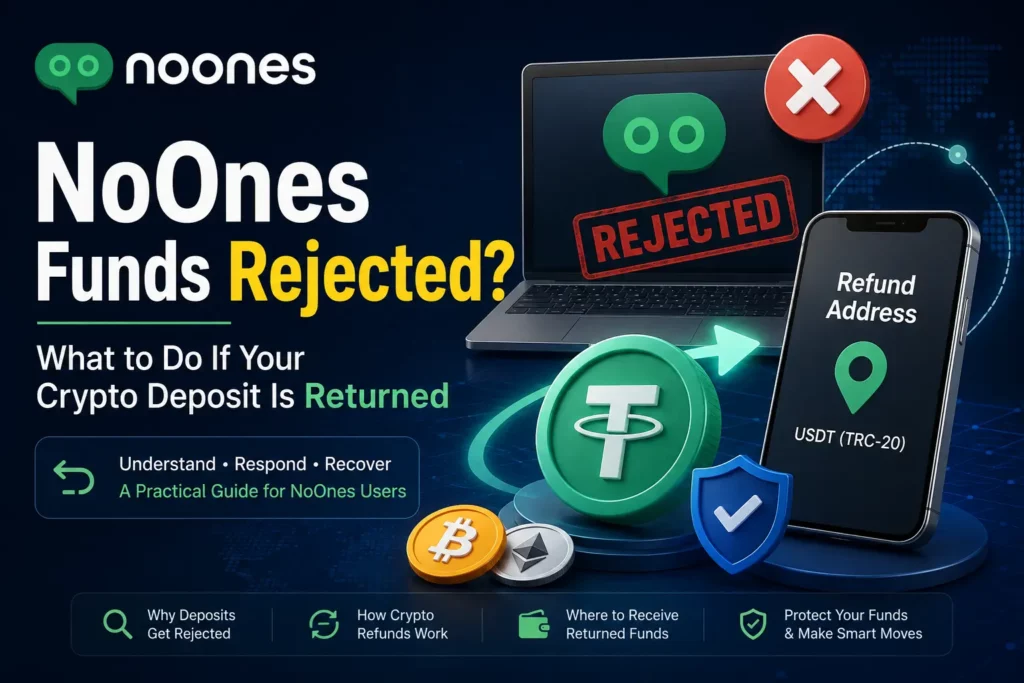
NoOnes has shut down its P2P marketplace, and many users have already started moving their remaining crypto elsewhere.
But for some users, withdrawing the funds is only the first step.
You may have already sent your Bitcoin or USDT from NoOnes to another exchange, only to find that the deposit has been delayed, placed under review, or rejected.
So what happens next?
And if the exchange agrees to send the funds back, where should you ask them to send the refund?
This guide explains what may happen and what you should check before providing a return address.
Why NoOnes Withdrawals Can Be More Complicated Now
NoOnes began winding down its services in August 2026. Its P2P marketplace closed, while several other services were also discontinued as the platform moved toward its shutdown.
According to NoOnes’ official wind-down update, Bitcoin withdrawals through the regular Bitcoin network and USDT withdrawals via TRC-20 remained available during the wind-down process.
That doesn’t necessarily mean every withdrawal will be treated the same once it reaches another platform.
You might successfully send crypto from NoOnes and see the transaction confirmed on the blockchain, but the receiving exchange may still decide to review the deposit before crediting it to your account.
In other words:
A successful blockchain transaction does not automatically mean that an exchange will accept and credit the deposit.
If you’re still trying to understand what happened to the platform in the first place, you can also read our guide on why NoOnes was sanctioned.
Why Would Another Exchange Reject a NoOnes Deposit?
Different exchanges have different compliance policies and internal risk controls.
Some platforms may apply additional checks to transactions associated with entities affected by sanctions or other restrictions.
For example, Bitget announced its compliance measures regarding transactions involving NoOnecrypto INC., including enhanced review or possible rejection in certain cases.
That means a transaction may go through something like this:
- You withdraw BTC or USDT from NoOnes.
- You send it to another exchange.
- The blockchain transaction is confirmed.
- The receiving platform reviews the transaction.
- The deposit is delayed, reviewed, or rejected.
Not every transaction will necessarily have the same result. It depends on the platform, its policies, the transaction itself, and its internal risk assessment.
The situation is also more complicated than simply asking whether NoOnes was “banned.” Our guide on what the EU sanctions actually mean for NoOnes users explains the broader situation.
What Happens If Your Deposit Is Flagged?
The first thing to do is not panic.
A flagged deposit does not automatically mean that your funds are lost.
Usually, there are several possible outcomes.
Your Deposit Is Still Under Review
The exchange may simply need more time to review the transaction.
In some cases, you may be asked to provide additional information, such as:
- the source of the funds;
- the transaction ID;
- withdrawal records;
- or other information related to the transaction.
Keep your withdrawal records and transaction hash. Don’t delete support emails or close the support ticket before the situation is resolved.
The Exchange Asks for More Information
Some platforms may ask you to explain where the funds came from or provide supporting documents.
If that happens, provide accurate information.
These types of checks are part of broader anti-money laundering and risk-management practices used across the financial and crypto industries. The Financial Action Task Force’s guidance on virtual assets and virtual asset service providers provides more context on how these risks are assessed.
Trying to give a false explanation or create a different transaction history can make the situation more complicated.
The Deposit Is Rejected
This is the situation many users are concerned about.
The receiving exchange may decide that it cannot credit the deposit to your account.
However, a rejected deposit does not necessarily mean that the platform will simply keep your crypto.
Depending on the platform and the specific case, it may offer to return the funds.
If that happens, you may be asked to provide a return address or refund address.
And this is where you need to slow down and make sure you provide the correct details.
My NoOnes Deposit Was Rejected. What Should I Do?
Let’s say this has already happened:
NoOnes → Another Exchange → Compliance Review → Deposit Rejected
The exchange then contacts you and confirms that it can return the funds.
It may ask you to provide an address where the crypto should be sent.
Don’t just copy the first wallet address you can find.
There are a few things you should check first.
Step 1: Confirm That the Funds Are Actually Being Returned
Make sure you understand exactly what the exchange is telling you.
There is a big difference between:
- Your deposit is still under review.
- Your deposit has been rejected.
- A refund has been approved.
- The refund has already been initiated.
If the transaction is still under review, wait for the platform’s instructions.
If the exchange has clearly confirmed that it will return the funds, follow its official refund process and keep the support ticket open until everything is completed.
Step 2: Confirm Which Asset Is Being Returned
If you originally deposited USDT, confirm that the exchange is returning USDT.
If you deposited Bitcoin, confirm that Bitcoin is being returned.
Don’t assume the platform will automatically convert the funds into another asset.
The address you provide must support the asset being returned.
Step 3: Confirm the Network
This is probably the most important technical detail.
Let’s say your original transaction was:
USDT via TRC-20
The refund address needs to support:
USDT on the TRON network
Not Ethereum.
Not BNB Smart Chain.
Not another network that also supports USDT.
The same asset can exist on multiple blockchain networks, and using the wrong network can cause serious problems.
Before submitting your refund address, confirm:
- the asset;
- the blockchain network;
- and whether the receiving wallet or platform supports both.
If you’re not sure, ask the exchange handling the refund before submitting the address.
Where Can You Receive a Returned Crypto Deposit?
If an exchange agrees to return your funds, you will need to provide a compatible destination.
There are generally a couple of options.
A Personal Wallet
You may choose to receive the funds in a wallet that you personally control.
This gives you control over the assets after they are returned, but self-custody also comes with responsibility.
Make sure you understand how to protect:
- your private keys;
- your seed phrase;
- your wallet backup;
- and the device you use to access the wallet.
You only need to provide the public wallet address for a crypto refund.
Never send your seed phrase, private key, password, or 2FA code to someone claiming they need it to process the return.
Another Compatible Platform
Depending on the asset and network, you may also be able to provide a deposit address from another compatible platform.
Before doing that, check:
- Does the platform support the asset being returned?
- Does it support the same network?
- Is your account active?
- Is the platform currently accepting deposits for that asset and network?
A different destination address does not erase the original blockchain transaction history.
The purpose of the refund address is simply to provide the sending platform with a compatible place to return the assets it has decided not to credit.
Can You Use a CoinCola Deposit Address to Receive the Refund?
If you already have a CoinCola account, a CoinCola deposit address may be one option when another platform asks you to provide a compatible address for a returned transaction.
The important part is that the address must support the same asset and network being returned.
For example, if another exchange confirms that it is returning:
USDT via TRC-20
you should first check that CoinCola currently supports USDT deposits on that network and then obtain the appropriate deposit address from your account.
Before submitting any address, make sure you understand the CoinCola deposit process and supported networks.
Don’t simply copy an old address or choose a random cryptocurrency from your account.
Before providing a CoinCola address, double-check:
- the asset being returned;
- the blockchain network being used;
- the current deposit requirements;
- the deposit address itself;
- and any instructions provided by the platform handling the refund.
It’s also important to be clear about what this does and does not mean.
Using a CoinCola deposit address as a refund destination does not change the original transaction history or remove the need to provide accurate information if either platform asks about the transaction.
The purpose is simply to receive funds that another platform has already decided to return.
Example: Your NoOnes Deposit Is Rejected by Another Exchange
Let’s look at a simple example.
You had USDT on NoOnes.
You withdrew the USDT through the TRON network and sent it to another exchange.
The blockchain transaction was confirmed, but the receiving exchange later contacted you and said that the deposit could not be credited to your account following its review.
The exchange then tells you that it can return the USDT and asks you to provide a compatible TRC-20 address.
The process might look like this:
Step 1: You receive confirmation that the deposit has been rejected.
Step 2: The exchange confirms that the funds can be returned.
Step 3: The exchange asks for a compatible refund address.
Step 4: You confirm that the refund will be sent as USDT on TRC-20.
Step 5: You choose a destination that supports USDT on TRC-20.
Step 6: If CoinCola currently supports that asset and network and your account meets the applicable requirements, you can provide the appropriate CoinCola deposit address as the refund destination.
Step 7: You submit the address through the exchange’s official refund process.
Step 8: You wait for the refund transaction and monitor the return.
The most important point is simple:
Only provide an address that supports the exact asset and network being returned.
And when communicating with the exchange, provide accurate information about the original transaction.
What You Should Not Do
When funds are already under review, trying to rush the process can create even more problems.
Here are a few things to avoid.
Don’t Send More Transactions While the First One Is Under Review
If one deposit is already being investigated, sending several more transactions may only create additional problems.
Wait for the platform’s instructions before making another move.
Don’t Provide False Information About the Source of Funds
If the platform asks where the funds came from, answer accurately.
The goal is to resolve the transaction, not create conflicting information.
Don’t Assume Another Wallet Removes the Transaction History
Moving crypto through several wallets does not automatically erase its previous blockchain history.
For example:
NoOnes → Wallet A → Wallet B → Exchange
does not mean the original transaction can no longer be analysed.
Don’t Use the Wrong Network
Always confirm the network before submitting your refund address.
USDT is especially important here because it is available on multiple networks.
Don’t Share Your Private Keys or Seed Phrase
A platform returning your crypto may need a public wallet address.
It should not need:
- your seed phrase;
- your private key;
- your CoinCola password;
- or your 2FA code.
If someone asks for those details, stop and verify who you are dealing with.
A Quick Checklist Before You Provide a Refund Address
Before replying to the exchange, take a minute to check the following.
About the refund
- Has the exchange officially confirmed that the deposit will be returned?
- Do I know exactly which asset is being returned?
- Do I know which network will be used?
About the destination
- Does my chosen destination support that asset?
- Does it support the same network?
- Is my account able to receive deposits?
- Did I copy the correct address?
About the transaction
- Have I saved the original transaction hash?
- Have I kept my withdrawal records?
- Have I saved the exchange’s support messages?
- Am I following the platform’s official refund instructions?
Taking a few minutes to check these details can save you from creating a second problem while trying to solve the first one.
What Should You Do After Your Funds Are Returned?
Once the funds have been safely returned, you can decide what to do next.
You might choose to:
- keep them in self-custody;
- move them to another platform;
- continue trading through P2P;
- or simply hold them until you decide on your next step.
If you’re moving away from NoOnes permanently, this is also a good time to compare CoinCola vs NoOnes and think about what you actually need from your next P2P platform.
Don’t choose based only on a welcome bonus or a slightly better exchange rate.
- escrow protection;
- trader reputation;
- liquidity;
- payment methods;
- dispute resolution;
- account security;
- and customer support.
Before choosing where to trade next, it’s also worth reading our guide on how to choose a safe P2P crypto exchange.
FAQ
NoOnes previously announced a withdrawal-only phase following the closure of its P2P marketplace. Users should check their NoOnes account and the latest official announcements for the current status of any available withdrawal options.
Different exchanges have different compliance and risk policies. A transaction may be delayed, reviewed, or rejected depending on the platform’s internal controls and its assessment of the transaction.
It depends on the exchange and the specific case. If the platform agrees to return the funds, it may ask you to provide a compatible wallet or deposit address. Follow the platform’s official instructions and keep your support ticket and transaction records.
A crypto refund address is the wallet or deposit address provided to receive assets that a platform is returning. The address must support the correct asset and blockchain network.
If CoinCola currently supports the asset and network being returned, and your account meets the applicable requirements, a compatible CoinCola deposit address may be used as a refund destination. Always check the current deposit details before submitting an address.
No. Moving crypto through another wallet does not automatically erase its previous on-chain transaction history.
The refund may fail, be delayed, or become difficult to recover. Always confirm both the asset and network before providing an address.
There is no fixed timeframe. It depends on the exchange processing the return, any remaining review procedures, the blockchain network, and the platform’s internal processes.
Final Thoughts
The NoOnes shutdown has created a problem that many users may not have expected.
You might successfully withdraw your crypto from NoOnes, but getting the funds accepted by another platform can be a separate issue.
If your deposit is delayed, reviewed, or rejected, the best thing to do is slow down and understand exactly what stage the transaction is at.
Keep your records.
Follow the receiving platform’s official instructions.
And if the platform agrees to return your funds, make sure you provide a compatible refund address that supports the correct asset and network.
If you decide to use CoinCola as the destination for a returned transaction, check the current deposit requirements and copy the correct address from your account before submitting it.
After the funds are returned, you can take your time deciding what to do next and choose a P2P platform based on the things that actually matter for your trading needs.