SWIFT vs Blockchain: Which Is Faster and Cheaper for International Transfers?
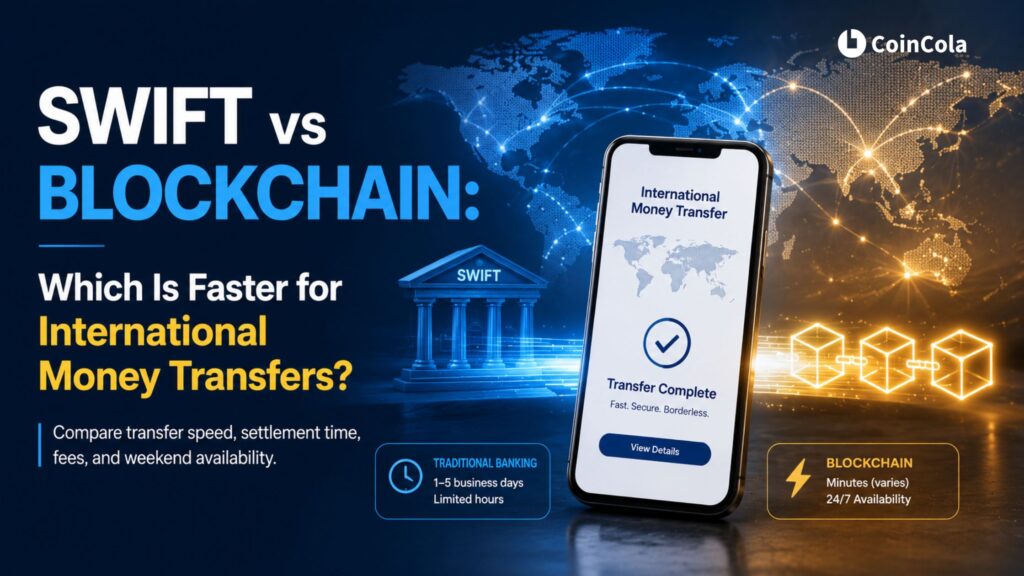
When sending money internationally, speed matters.
Whether you’re supporting family overseas, paying suppliers, or transferring funds between countries, waiting several business days for a payment to arrive can be frustrating.
Today, most cross-border payments use one of two approaches:
- Traditional bank transfers through the SWIFT network
- Blockchain-based transfers using cryptocurrencies and P2P marketplaces
Both are widely used, but they work very differently. Understanding how each system operates can help you choose the right option for your next international money transfer.
What Is SWIFT?
SWIFT (Society for Worldwide Interbank Financial Telecommunication) is a global messaging network used by thousands of financial institutions.
Contrary to popular belief, SWIFT does not actually move money. Instead, it securely transmits payment instructions between banks.
A typical SWIFT transfer may involve:
- The sending bank
- One or more correspondent banks
- The receiving bank
Each institution processes its part of the transaction before the recipient receives the funds.
This multi-bank process is one reason international bank transfers often take one to five business days.
How Does Blockchain Work?
Blockchain uses a decentralized network to record and verify transactions.
Instead of relying on multiple banks, transactions are confirmed by distributed network participants.
For international payments, blockchain is often combined with crypto-powered P2P marketplaces.
A simplified process looks like this:
- Purchase cryptocurrency.
- Transfer it on the blockchain.
- Sell it through a P2P marketplace.
- Receive local currency via bank transfer from the buyer.
Because blockchain networks operate continuously, transactions can be initiated at any time rather than waiting for banking business hours.
SWIFT vs Blockchain: Speed Comparison
| Feature | SWIFT | Blockchain + P2P |
|---|---|---|
| Network availability | Banking schedule | 24/7 |
| Typical processing | 1–5 business days | Depends on blockchain confirmation and counterparties |
| Weekend availability | Limited | Available |
| Intermediary banks | Often required | Not required for blockchain settlement |
| Settlement transparency | Limited | Transactions recorded on-chain |
While blockchain transactions themselves are typically confirmed much faster than traditional banking messages, the total completion time still depends on factors such as network congestion, buyer response time, and local payment processing.
Why Are SWIFT Transfers Sometimes Slower?
Several factors can increase processing time.
Banking Hours
Many banks process international transfers only during business hours.
A payment submitted late on Friday may not continue processing until Monday.
Compliance Reviews
AML and KYC checks may require additional verification, particularly for:
- First-time transfers
- Large transaction amounts
- Certain destinations
Correspondent Banks
Some transfers pass through several financial institutions before reaching the recipient.
Each additional processing step may increase delivery time.
When Does Blockchain Have an Advantage?
Blockchain-based transfers can be particularly useful when speed and flexibility are important.
Examples include:
- Sending money during weekends
- Cross-border payments outside banking hours
- Countries with slower banking infrastructure
- Users who already hold digital assets
Rather than depending entirely on banking schedules, blockchain networks remain operational around the clock.
Speed Isn’t Everything—Consider the Total Cost
Fast delivery is important, but it’s only one part of the equation.
Before choosing a transfer method, compare:
- Transfer fees
- Exchange rate
- Delivery speed
- Security
- Recipient payout options
Even providers advertising “low fees” may apply less competitive exchange rates.
To understand the full cost of sending money abroad, read our guide to International Transfer Fees.
Sending Money to Nigeria? Exchange Rates Matter
If you’re transferring funds to Nigeria, the exchange rate can have a significant impact on the amount your recipient receives.
Even a small difference in the USD/NGN rate becomes meaningful for larger transfers.
Before initiating your transfer, check the latest USD to NGN exchange rate and understand the factors that influence daily currency movements.
If your destination is Nigeria, our complete guide on how to Send Money to Nigeria compares traditional bank transfers, online remittance services, and crypto-powered P2P transfers.
Which Option Is Better?
There is no universal winner.
SWIFT may be suitable when:
- Sending funds directly between bank accounts
- Corporate banking requirements apply
- Traditional banking relationships are preferred
Blockchain-powered transfers may be a better fit when:
- Faster settlement is important
- Weekend availability matters
- Users want greater flexibility
- Cross-border payments need to be completed outside normal banking hours
The best solution depends on your destination, payment method, budget, and urgency.
🎉 New User Bonus: Earn Up to 0.00014 BTC (≈ USD $9)
If you’re new to CoinCola, you can earn Bitcoin rewards simply by completing your first P2P trades.
Reward 1 — First P2P Trade
Complete your first P2P trade within 7 days of registration and receive:
🎁 0.00004 BTC
Requirements:
- New user
- Complete KYC verification
- Retail users only
- BTC P2P trade
- Valid across all trading regions
Reward 2 — Trade a Total of USD $500
Accumulate USD $500 in P2P trading volume within 7 days of registration and receive an additional:
🎁 0.00010 BTC
Requirements:
- New user
- Complete KYC verification
- Retail users only
- BTC P2P trade
- Valid across all trading regions
Total Welcome Rewards
Complete both activities to earn:
✅ Total Bonus: 0.00014 BTC (approximately USD $9)
Whether you’re making your first international transfer or exploring crypto-powered cross-border payments, it’s an easy way to get started while earning Bitcoin rewards.
Create your CoinCola account today and start trading to unlock your welcome bonus.
Final Thoughts
SWIFT and blockchain each play an important role in today’s global payment ecosystem.
Traditional bank transfers remain a trusted option for many users, while blockchain-powered transfers offer an alternative that operates beyond conventional banking hours.
Before making your next transfer, compare the total cost, delivery speed, exchange rate, and payment method—not just the advertised transfer fee—to choose the solution that best fits your needs.